Can Black Mold Be Fully Remediated? What the CDC Says
Updated
Get a free quote
We reply with a price. Nothing is booked until you say yes.
Rather talk? Call (815) 420-4117 or text us.
Short answer
Part of mold remediation in Rockford, IL.
What "black mold" usually means
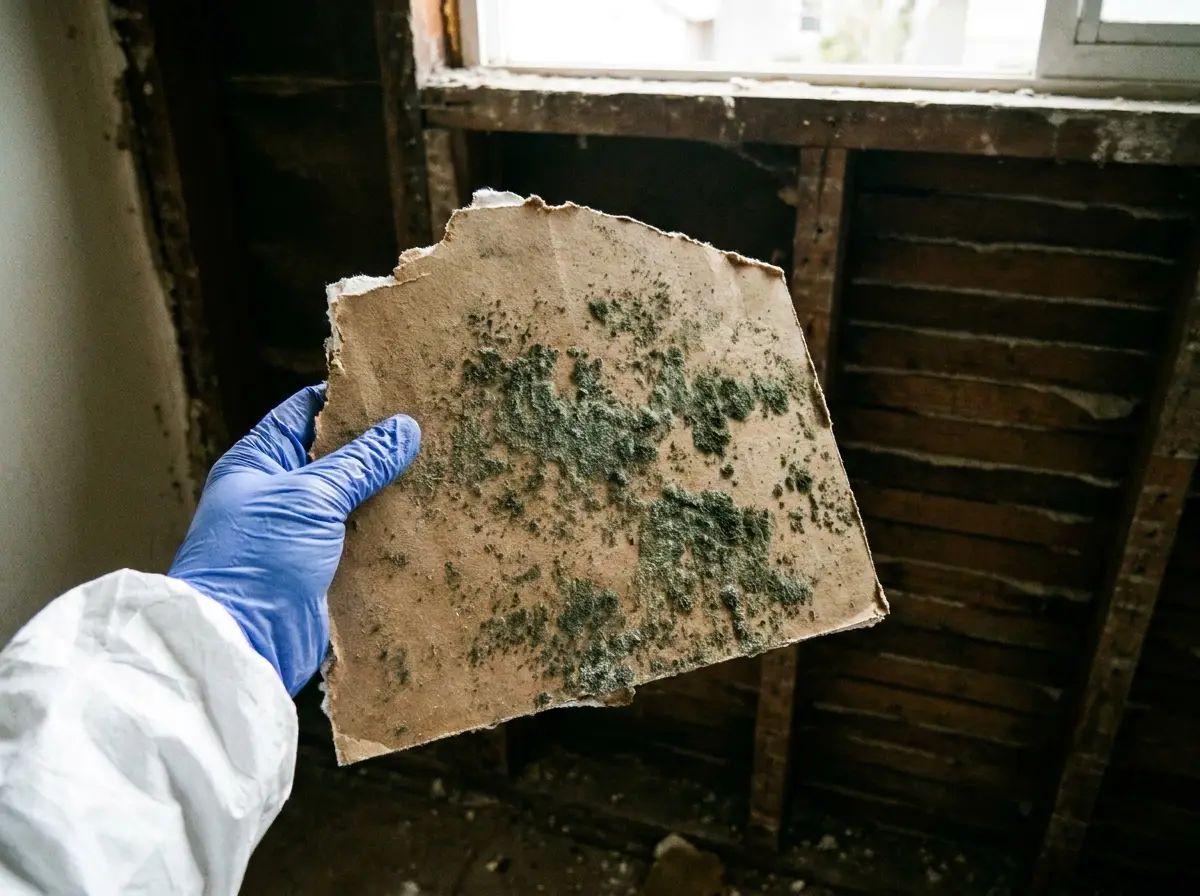
The CDC describes Stachybotrys chartarum as a greenish-black mold that grows on material high in cellulose, like fiberboard, gypsum board and paper, when there is constant moisture (CDC mold facts). That is why it turns up on the paper face of drywall behind a slow leak or in a basement that flooded and was closed up wet. Plenty of other molds are dark too; you can't tell the species by looking.
Is it more dangerous than other mold?
CDC's NIOSH says color does not tell you how dangerous a mold is. Certain molds are toxigenic, meaning they can produce toxins, but "the molds themselves are not toxic or poisonous," and Stachybotrys "should be considered the same as other molds that can grow in your house" (CDC/NIOSH). A possible link to lung bleeding in infants was studied and, per the CDC, has not been proven.
Any mold can cause trouble for some people. The CDC lists stuffy nose, sore throat, coughing or wheezing, burning eyes and skin rash, with worse reactions in people with asthma or mold allergy, and lung infections possible in people with weak immune systems or chronic lung disease (CDC, mold and your health). That is the reason to remove it, whatever its color.
Can it be fully remediated?
The growth can be removed completely; the spores in the air cannot, for black mold or any other kind. The EPA says it is impossible to get rid of all mold and spores indoors and that the key is moisture control (EPA). The professional standard, ANSI/IICRC S520, sets the goal as returning the area to a normal fungal ecology, its Condition 1 (IICRC S520). In practice, for black mold on drywall:
- Contain the area with plastic and negative air before anything is cut.
- Remove the drywall, insulation and other porous material with growth, bagged inside containment.
- HEPA-vacuum and clean the studs, sill plate and any hard surfaces.
- Fix the leak or seepage and dry the framing to normal moisture.
- Check that visible growth and the musty odor are gone before the wall is closed up.
Do you need to test which mold it is?
Not to decide on cleanup. IDPH, the EPA and the CDC all say visible mold does not need a test to justify removing it, and knowing the species does not change the method. See do you need a mold test.
Who should stay out
The CDC says people with asthma or other lung conditions, and people with weak immune systems, should not go into a building with visible or smelled mold, and children should not help with cleanup (CDC). Above about 10 square feet, IDPH says a professional should do the work. Black mold removal prices are on the mold remediation cost page, and the service itself on the mold remediation Rockford homepage.
Want a price for your own home?
Call, text, or send the form with where the mold is and what got wet. You get a written price before any work starts.
Quick answers
Can black mold be completely removed?
The growth can be removed completely by cutting out porous material and cleaning the rest. The EPA says no one can remove every spore indoors, which is why fixing the moisture matters.
Is black mold more dangerous than other mold?
CDC/NIOSH says color does not tell you how dangerous a mold is and that Stachybotrys should be considered the same as other household molds. Any mold can affect sensitive people.
Should I test black mold to find out what kind it is?
Knowing the species does not change the cleanup. IDPH, the EPA and the CDC say visible mold does not need testing to justify removal.
Can I clean black mold myself?
The EPA and IDPH say areas under about 10 square feet on hard surfaces can be a DIY job with an N95 respirator, gloves and goggles. Larger areas, mold inside walls, and anyone with asthma or a weak immune system call for a professional.
Rather have it handled?
Tell us where the mold is and what got wet. We reply with a written price first, and nothing starts until you agree.