Get a free quote
We reply with a price. Nothing is booked until you say yes.
Rather talk? Call (815) 420-4117 or text us.
Short answer
1. Find the water
Every job starts with where the moisture comes from: a leak, seepage through a basement wall, condensation on a cold roof deck, an AC coil, or a flood. A moisture meter maps how far wet material runs behind what you can see. The EPA says that if the water problem is not fixed, mold will most likely come back, so the source is named in the written scope.
2. A written scope and price
We sends what gets contained, what gets removed, what gets cleaned and what fixes the moisture, with a price. Testing is usually not part of it when the mold is visible: IDPH, the EPA and the CDC all say it is generally unnecessary. Nothing starts until you agree.
3. Containment
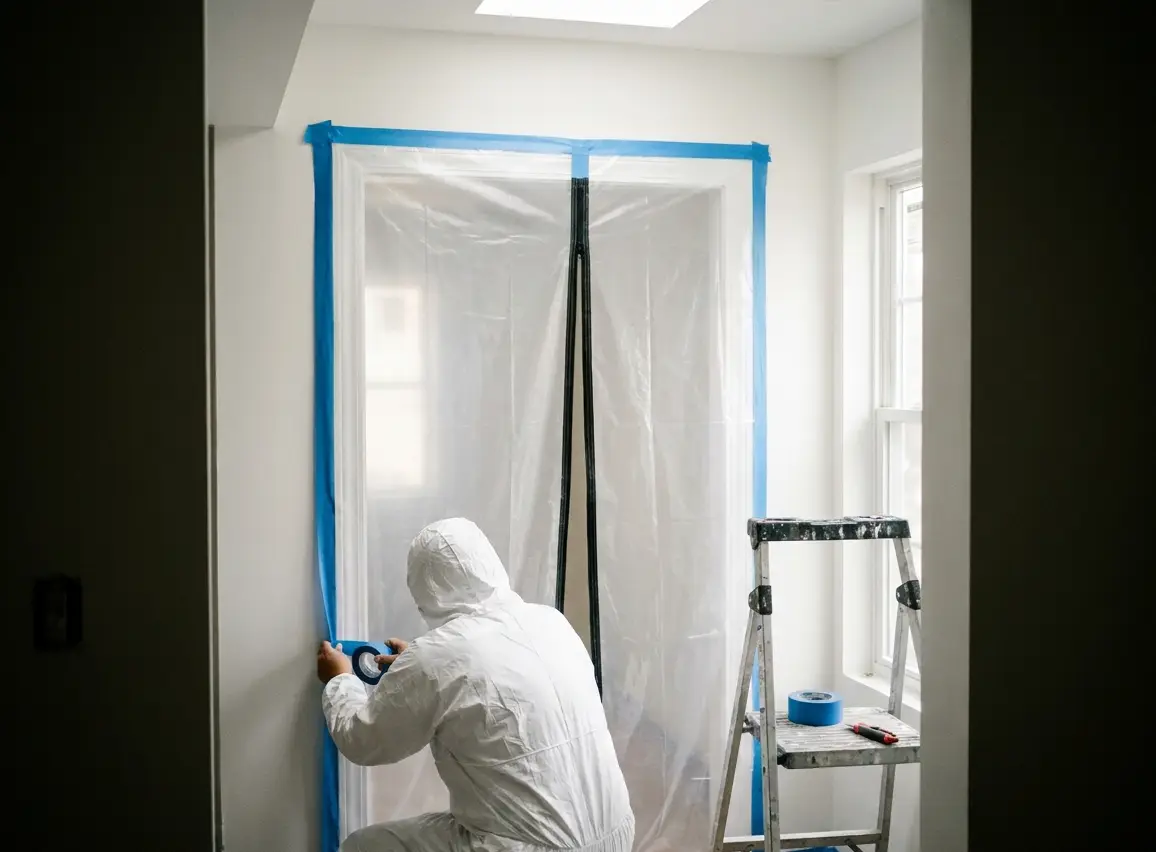
The work area is closed off with plastic sheeting and a zipper door, and an air scrubber with a HEPA filter pulls air out of it, often through a window, so the area stays under negative pressure and spores do not drift into the rest of the house. HVAC vents in the area are closed and sealed.
4. Removal
Porous material with growth, such as drywall, insulation, ceiling tile and carpet pad, is cut out and double-bagged inside containment. IDPH's cleanup steps say to discard heavily damaged porous material rather than try to clean it.
5. Cleaning
Framing, block, sheathing and other hard surfaces are HEPA-vacuumed and wet-cleaned. Wood that is stained but sound is cleaned, not replaced.
6. Drying
Dehumidifiers and air movers run until materials are back to normal moisture. The EPA's guideline for indoor humidity is 30 to 60 percent, and nothing should be closed up wet.
7. Checking the work
The EPA's test for a finished job: the water problem is fixed, visible mold and moldy odors are gone, and if anyone samples, the kinds and amounts of mold indoors look like outdoors. Then containment comes down and rebuilding can start.
Why containment matters most
Cutting moldy drywall puts spores in the air. Without plastic walls and negative air, they settle in the next room, and what the IICRC S520 standard calls a Condition 2 area, settled spores from somewhere else, spreads through the house. That is the difference between remediation and a quick tear-out. See mold removal vs mold remediation.
Before anything is cut in an older home
Many Rockford houses are old enough for asbestos in plaster, joint compound or floor tile. Illinois EPA advises a qualified inspection before renovation, and for buildings of five or more units the federal asbestos rule requires one. Prices for every step are on the mold remediation cost page, and the services by area of the house on the mold remediation Rockford homepage.
Sources: U.S. EPA, How do I get rid of mold?; U.S. EPA, Mold cleanup in your home; U.S. EPA, Ten things you should know about mold; U.S. EPA, Mold course chapter 7 (evaluating remediation); U.S. EPA, Is sampling for mold needed?; IDPH, Mold FAQs; CDC/NIOSH, Mold testing and remediation; CDC, Asthma clinical guidance; U.S. EPA, Should you have the air ducts in your home cleaned?; IICRC, ANSI/IICRC S520 Standard for Professional Mold Remediation; Illinois EPA, Asbestos in your house or apartment
Process questions
What happens during mold remediation?
The moisture source is found, the area is contained under negative air, moldy porous material is cut out and bagged, hard surfaces are HEPA-vacuumed and cleaned, everything is dried, and the result is checked before walls are closed up.
Is it safe to stay home during mold remediation?
For a contained job in one area, most households stay; that is what containment is for. The CDC says people with asthma, lung disease or weak immune systems should not be in a building with visible mold, so they may be better off elsewhere until the work is done.
Is mold remediation toxic?
The main exposure is the mold itself being disturbed, which containment and HEPA filtration address. The EPA cautions about chemical biocides in ducts, and remediation that removes growth and fixes moisture does not depend on spraying chemicals.
How long does mold remediation take?
A bathroom or a small area can be a day; a basement with wet drywall on several walls takes longer because of drying time. The written scope should give the timeline for your job.
Do I need a mold test after remediation?
The EPA says surface sampling can help confirm a cleanup worked, and it matters most when someone in the home is sensitive to mold. The EPA's main test is simpler: water fixed, no visible mold, no musty odor.
Start with a written scope
Tell us where the mold is and what got wet. You get the scope and the price before anything is scheduled.